

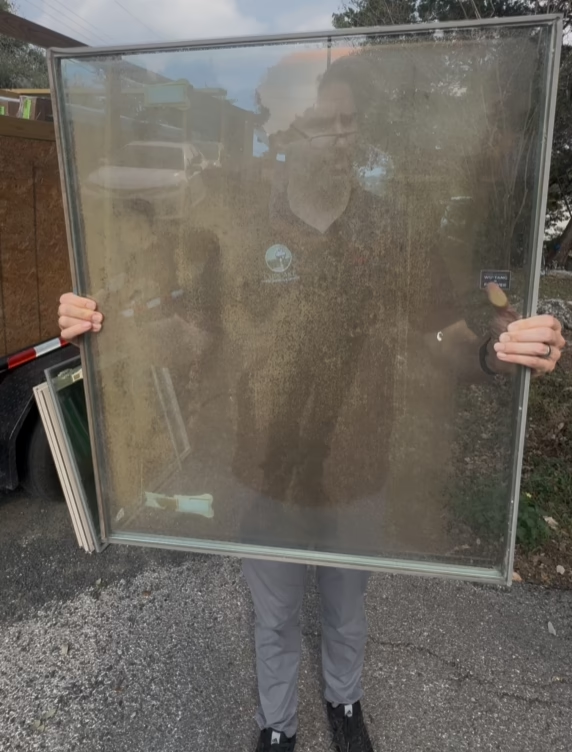
Foggy Windows: What Causes Seal Failure and What to Do About It
Foggy windows — a hazy, cloudy, or streaky appearance between the panes of glass that cannot be wiped away from either surface — are a sign that the insulated glass unit has failed. The seal that keeps inert gas locked between the panes has broken down, outside air has entered, and the window’s insulating performance has been permanently compromised. This is not a cleaning problem and it is not reversible. Understanding what causes seal failure, how fast it progresses, and what the replacement process looks like is the starting point for making the right decision about foggy windows in your home. For the full list of window problems common to Central Texas homes, see the common window problems overview or the replacement windows overview.
What Is Actually Happening Inside a Foggy Window
Modern replacement windows are built around an insulated glass unit — two or three panes of glass separated by a spacer and sealed at the perimeter. The space between the panes is filled with an inert gas, typically argon or krypton, which provides significantly better thermal insulation than air alone. Low-emissivity coatings on the glass surfaces reduce radiant heat transfer. Together these components make a modern window far more thermally effective than a single pane of glass.
The seal at the perimeter of the IGU is what holds this system together. When that seal fails — through age, thermal cycling, moisture intrusion, or mechanical stress from improper installation — the inert gas escapes and is replaced by ordinary outside air. Outside air carries moisture. That moisture enters the space between the panes, condenses on the interior glass surfaces when temperatures change, and produces the hazy or cloudy appearance that homeowners recognize as a foggy window. Once the seal is gone, the gas fill cannot be restored and the moisture cycle continues.
What You Lose When the Seal Fails
The inert gas fill accounts for a meaningful portion of a modern window’s insulating value. Once it escapes and is replaced by air, the window’s U-factor — its resistance to heat transfer — degrades significantly. The window is now performing closer to a single pane than the double or triple pane unit you paid for. In Central Texas summers, that degraded performance translates directly to higher indoor temperatures near the glass, more HVAC load, and higher energy costs.
How It Differs From Inside Condensation
Foggy glass between the panes is distinct from condensation that forms on the room-side surface of the glass. Inside surface condensation is a humidity problem — the window is fine, the indoor air has too much moisture relative to the glass temperature. Between-pane fogging is an IGU failure — the window itself has failed regardless of indoor humidity conditions. The diagnostic distinction matters because the correct response is completely different. The full breakdown of condensation types is covered on the window condensation page.
What Causes IGU Seal Failure
Seal failure is not random. It has identifiable causes, and understanding them matters both for evaluating why a current window has failed and for making decisions about what to replace it with.
Thermal cycling
Glass and the spacer material expand and contract with temperature changes. In Central Texas — where summer temperatures regularly exceed 100°F and winter nights can drop below freezing — this thermal cycling is more extreme and more frequent than in moderate climates. Every cycle puts stress on the seal at the perimeter of the IGU. Over years, that cumulative stress degrades the sealant and eventually allows the gas fill to escape. Windows in full sun exposure experience more severe cycling than shaded windows and typically reach seal failure sooner.
Improper installation
A window that is not correctly shimmed, squared, and secured in the opening is under mechanical stress from the moment it is installed. That stress — the frame racking slightly, the glass unit flexing with building movement — works on the seal continuously and accelerates the failure timeline significantly. A window that should perform for 20 years before seal degradation becomes a concern can fail in a fraction of that time if installation introduced stress points the unit wasn’t designed to handle. How installation is done correctly, and what separates a proper installation from a shortcut, is covered on the installation process page.
Moisture intrusion at the frame
Water that enters around the window frame — through failed caulk, improper flashing, or damaged frame material — can reach the spacer at the edge of the IGU and accelerate seal breakdown from the outside. Wood frames that have absorbed moisture and begun to deteriorate are particularly likely to allow water to reach the glass unit perimeter. Frame material selection plays a meaningful role in how susceptible a window system is to this failure path — the window frame materials overview covers how different materials respond to moisture exposure over time.
Age and product quality
Every IGU seal has a finite service life. Higher-quality units from reputable manufacturers use better sealant formulations, higher-grade spacer materials, and more rigorous quality control — all of which extend the performance life of the seal before failure becomes likely. Lower-quality units, or windows manufactured to a price point rather than a performance standard, tend to reach seal failure earlier. This is one of the reasons brand and product quality matter when selecting replacement windows — not just how the window looks or what it costs initially. The brands Cupcake installs in the Greater Austin Metro, and what distinguishes them on IGU quality and warranty coverage, are covered on the window brands overview.
How Foggy Windows Progress Over Time
Seal failure is not always immediately obvious. It typically progresses through recognizable stages, and catching it early affects both the replacement scope and the extent of any secondary damage to the surrounding frame and wall.
Early Stage
- Slight haze that appears and disappears with temperature changes — most visible in the morning or on cold days, less apparent at midday
- Light cloudiness at the edges of the glass unit where the spacer runs — seal failure typically begins at the perimeter before spreading inward
- Window still provides some insulating value but gas fill is already compromised
Advanced Stage
- Persistent fogging that no longer clears — moisture has fully saturated the interior space and condensation now forms regardless of conditions
- Visible mineral deposits or staining on the interior glass surfaces from repeated condensation cycles — these cannot be cleaned from inside the sealed unit
- Significant loss of insulating performance — the window is effectively single-pane in thermal terms
- Potential secondary damage to the frame and surrounding wall from moisture that has tracked outward from the failed unit
IGU Replacement vs. Full Window Replacement
When an IGU fails, the question is whether to replace the glass unit alone or the full window including the frame. The answer depends on the age and condition of the frame and the overall window system.
If the frame is in good condition — structurally sound, no rot or significant moisture damage, seals and weatherstripping intact — replacing just the IGU is a reasonable scope. The failed glass unit is removed from the existing frame and a new insulated unit is installed in its place. This is less disruptive and less expensive than full window replacement and makes sense when the frame itself still has meaningful service life remaining.
If the frame shows deterioration — wood rot, moisture damage, failed weatherstripping, or operational problems — replacing only the glass unit puts a new IGU into a compromised frame that is likely to accelerate seal failure in the replacement unit as well. In that scenario, full window replacement is the more cost-effective path. Frame material affects this calculus significantly: wood frames that have been exposed to chronic moisture are more likely to warrant full replacement, while intact vinyl frames with no structural issues are better candidates for IGU-only replacement. Window type is also worth considering at this stage — replacing a failed unit is an opportunity to evaluate whether the current window type is still the right fit for the opening in terms of ventilation, light, and performance. The full index of replacement window types available in the Greater Austin Metro is on the window types overview. What replacement windows cost across different scopes and frame types is covered on the window replacement cost page.
Frequently Asked Questions: Foggy Windows
Can foggy windows be fixed without replacing the glass?
No — not in any meaningful way. Some services advertise drilling small holes into the IGU, injecting a cleaning solution, and resealing the unit. This may temporarily reduce the fogging appearance but it does not restore the gas fill, does not restore the window’s insulating performance, and does not address the underlying seal failure. The fogging typically returns. The only repair that actually resolves the problem is replacing the IGU or the full window unit.
How long do window seals typically last?
A well-manufactured IGU installed correctly in a moderate climate can maintain seal integrity for 20 years or more. In Central Texas — with more severe thermal cycling, intense UV exposure, and higher average temperatures — realistic service life is shorter, typically 15 to 20 years for quality units installed properly. Lower-quality units or windows with installation stress points can begin showing seal failure in 5 to 10 years. The wide range reflects how significantly product quality and installation method affect seal longevity.
Do foggy windows affect energy bills?
Yes, meaningfully. A failed IGU has lost its gas fill and is performing at a fraction of its rated insulating value — in thermal terms it is closer to a single-pane window than the double or triple pane unit it was designed to be. In Central Texas summers, that degraded insulating performance allows significantly more heat transfer through the glass, increasing the load on your HVAC system. The energy cost impact of multiple failed IGUs across a home can be substantial over a full cooling season.
Can I replace just one foggy window or do I need to replace them all?
You can replace individual units. Seal failure does not spread from one window to adjacent windows — each IGU fails independently based on its own condition, installation, and exposure. That said, if multiple windows in a home are showing early fogging or are the same age and product, it is worth evaluating whether a broader replacement scope makes more sense than replacing units one at a time as each fails. A professional assessment can identify which units are at early stage versus advanced failure and help prioritize the scope.
Why did my windows fog up so soon after installation?
Premature seal failure — within the first few years of a window’s life — is almost always either a product quality issue or an installation problem. A window that was installed with inadequate shimming, improper sealing at the perimeter, or without correct flashing is under mechanical stress that accelerates seal degradation from day one. If your windows are fogging significantly ahead of what their warranty or expected lifespan suggests, installation quality is the first thing to evaluate — not just the product itself.
Are foggy windows covered under warranty?
Most reputable window manufacturers include an IGU seal failure warranty — typically 10 to 20 years depending on the brand and product line. Whether that warranty applies depends on whether the window was installed by an authorized installer following the manufacturer’s installation requirements, whether the warranty was properly registered, and whether the failure mode qualifies under the warranty terms. Seal failure resulting from improper installation is frequently excluded. Understanding what the warranty covers — and whether your installation qualifies — is an important part of evaluating a replacement window purchase.
Foggy Windows? Let’s Find Out What You’re Actually Dealing With.
A free consultation covers window condition, seal integrity, and frame health — so you know whether you need an IGU replacement, a full window replacement, or something else entirely before any decisions are made.
- Seal and frame condition assessed at no cost
- IGU vs. full replacement recommendation explained clearly
- No deposit required to get started
- Written scope before any work begins