

Siding Replacement Greater Austin Metro


No Deposit. No Pressure. No Excuses. Just Siding Done Right.
Most siding projects in Austin do not start because the house is falling apart. They start because homeowners are tired of repainting, tired of patching, or tired of looking at an exterior that never quite looks right no matter how much money goes into it. In Central Texas, heat, UV, wind-driven rain, and humidity accelerate that frustration and expose weak installation details fast.
Siding replacement is one of the few projects that can reset the entire exterior of a home at once — appearance, durability, maintenance burden, and how the wall system actually handles water. Done correctly, it gives the home a cleaner look, a more durable envelope, and fewer repeat problems. Done incorrectly, it just seals old problems behind new materials.
Cupcake Home Improvements replaces siding for Austin-area homeowners who want clear scope, disciplined installation, and an exterior that holds up here. We evaluate first and recommend second, so you are not buying a new exterior with the original problems still sitting behind it.
James Hardie Fiber Cement
The most durable readily available cladding for Central Texas conditions — engineered for this climate, non-combustible, dimensionally stable under heat, and installed to a higher standard than contractor-minimum work.
Free Siding Assessment
We assess cladding condition, probe for soft spots, inspect seams and trim transitions, and explain what we find before any scope recommendation is made.
Siding Types
Fiber cement, vinyl, Masonite hardboard, and T1-11 are the four materials most relevant to Austin-area homeowners, whether you are choosing a replacement or identifying what is currently on the house.
Common Siding Problems
Warping, rot, paint failure, and animal damage are the most common siding problems on Austin homes — and most of them trace back to a specific root cause.
Installation Process
Siding that fails early almost always fails because of installation shortcuts — skipped flashing, wrong WRB, framing issues, or fasteners driven incorrectly. Our installation sequence matters.
Siding Cost
Siding replacement in Austin usually runs $1,500–$2,500 per square installed for a complete scope. A lower quote usually means something important is missing from the project.
Recent Siding Projects Across the Austin Area
Real siding replacements completed for Austin-area homeowners — before and after, different materials, different conditions. This is what a properly scoped exterior project looks like when the installation details are handled correctly.
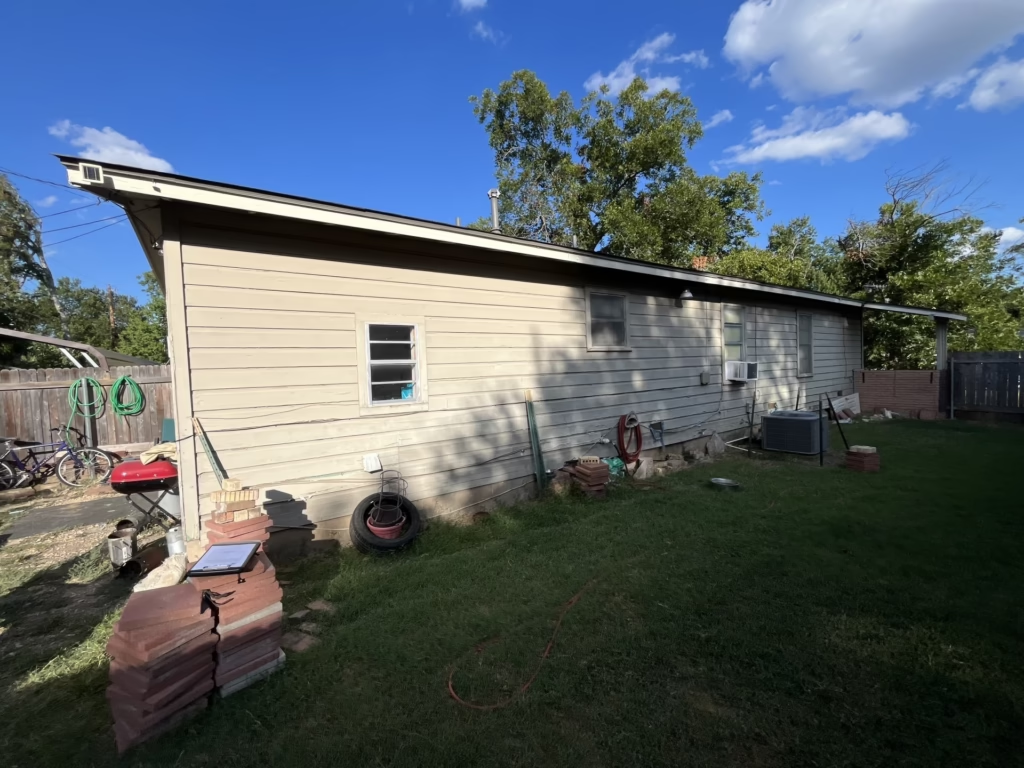
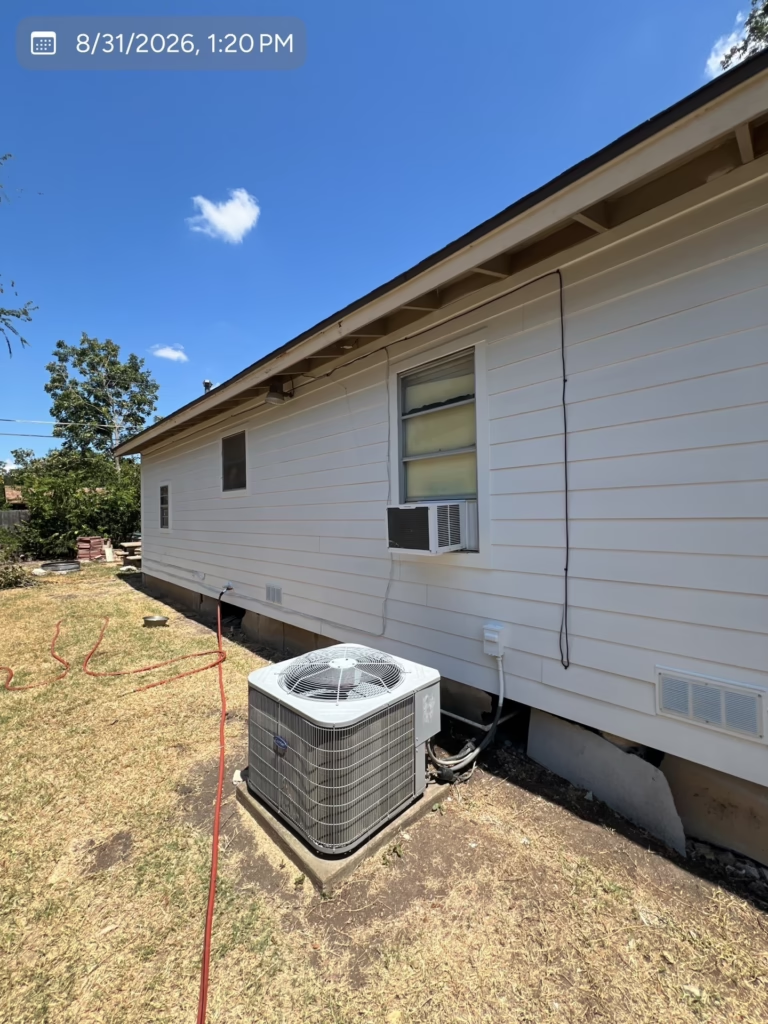


Thinking about replacing your siding? A free assessment shows you what your home needs — and what it doesn’t — before you commit to anything.
Why Homeowners Choose Cupcake for Siding Replacement
Most siding contractors replace boards. We restore the exterior envelope — and there is a difference. A siding project is not finished when the last trim piece is nailed on. It is finished when the wall system manages water correctly, the scope was honest, and the homeowner knows the job was done to last.
- No deposit required — work begins without upfront payment, because we are not worried about finishing what we start
- 10-year workmanship warranty — coverage on installation quality, not just the manufacturer’s product warranty
- We Break It, We Buy It — if our crew damages your property, we repair it
- Defined scope before production — installation method, materials, and substrate corrections are documented before anything is torn off
- Full tear-off on every project — no new cladding over unknown substrates, no hidden problems sealed in behind new siding
- Preferred-standard installation — not the contractor minimum that keeps the warranty technically intact
- Proactive communication throughout — you know what is happening at each stage before we show up, not after
These are operational commitments documented in writing before work begins, because siding replacement should solve problems permanently — not cosmetically.
Siding That Holds Up in Central Texas
Central Texas exposes weak siding systems fast. UV breaks down finishes, heat cycles move materials daily, and wind-driven rain finds every skipped detail at seams, penetrations, and trim transitions.
Fiber cement — especially James Hardie — remains the strongest mainstream siding choice for this climate when installed correctly. It resists heat distortion, holds paint longer, and stays dimensionally stable where other materials struggle.
But the product alone does not determine the result. The same siding installed two different ways can produce completely different performance over time. The outcome depends on scope, substrate condition, flashing, weather barrier integration, and installation discipline.
What Most Siding Quotes Leave Out
Siding replacement cost is not just about the material — it is about what is included in the scope behind it.
A lower quote usually means something is missing: no full tear-off, no substrate correction, incomplete flashing, weak WRB details, or shortcuts in the installation sequence. Those omissions rarely show up on installation day. They show up later as peeling paint, soft spots, moisture intrusion, and premature failure.
The difference between a siding job that lasts and one that does not is usually hidden underneath the finished surface. That is why scope clarity matters as much as price.
When Siding Replacement Makes Sense
Some homeowners replace siding because it is failing. Others replace it because they are tired of the repaint cycle, tired of patching, or ready to upgrade the exterior permanently. Both are valid. The point is to understand what is actually happening on the house before deciding how far to go.
⚠️ Signs Worth Having Assessed
- Soft or spongy sections when pressed firmly — especially at base courses and window surrounds
- Paint peeling repeatedly in the same locations despite repainting
- Wavy, buckled, or irregular surfaces that were not there originally
- Swelling at bottom edges, seams, or groove channels
- Woodpecker holes or rodent chewing concentrated in specific sections
- Water staining on interior walls adjacent to exterior sections
- Gaps at seams or trim transitions opening up over time
None of these automatically means full replacement, but they do tell you the siding is no longer performing the way it should. Common siding problems and what they mean →
📊 Realistic Siding Lifespan in Central Texas
Lifespan varies significantly by material, installation quality, and maintenance. Central Texas heat and UV exposure shorten real-world performance versus manufacturer claims.
10–20 yrs
15–25 yrs
20–30 yrs
30–50 yrs
Whether your siding is failing or you are just done maintaining it, we will help you define the right scope and the right replacement path.
Why Installation Quality Determines Whether Your Siding Lasts
Siding is cladding, not a waterproofing system. It manages water by directing it away from the wall assembly. When siding fails early, the cause is almost always one of these: flashing omitted, clearances ignored, WRB skipped or installed incorrectly, fasteners overdriven, or substrate corrections deferred to keep the project moving.
A siding job can look clean from the street on installation day and still be wrong underneath. The problems show up later as paint failure, soft spots, swelling, or moisture intrusion — and the product gets blamed when the real failure was installation.
This is why installation standard matters as much as material selection. A premium product installed carelessly will develop problems that a properly installed mid-range product will not.
Siding Replacement Cost in Austin
Cost depends on scope — and scope depends on what the wall system actually needs. The range below reflects complete, correctly scoped projects with James Hardie fiber cement. A quote significantly below these ranges is usually missing something from the job.
* Prices are local estimates. Substrate correction, framing repairs, and story count affect final project cost. Your actual quote is free.
Diagnosing Common Siding Problems
Most siding problems on Austin homes have a specific cause and a specific correct response. These guides cover the four most common problems Central Texas homeowners encounter, with enough diagnostic detail to understand what the symptom usually means and what the correct response involves.
Siding Warping and Buckling
Warping can come from vinyl thermal movement, moisture-driven swelling in wood-based materials, or fiber cement that looks uneven because of installation shortcuts. The cause matters.
Siding Rot and Soft Spots
Rot is the late-stage sign of moisture failure. The critical question is whether it is confined to the siding or has already reached sheathing and framing behind it.
Siding Paint Peeling
Peeling paint is rarely just a painting issue. It usually points to substrate breakdown, moisture problems, or installation details that were never corrected.
Animal Damage
Woodpecker holes and rodent chewing are often symptoms of material breakdown underneath. Patching without fixing the root condition rarely holds.
Not Sure What Material Is on Your Home — or What It Should Be Replaced With?
Austin’s 1980s–1990s housing stock was built with hardboard and T1-11, both of which are now aging out. Understanding what is on your home, how it typically fails, and what the right replacement material is for this climate are three different questions. The siding types overview answers all three.
Related Services Worth Evaluating at the Same Time
Siding, roofing, gutters, and windows all connect to the same wall assembly. If one system is aging or showing failure, the others often are too — and addressing them in the right sequence usually creates a better long-term result.
Roofing — Controls Water at the Top of the Wall
Siding failure at the roofline is often a flashing problem, not a siding problem first. If the roof is aging or roof-to-wall details are wrong, that should be addressed before or during a siding project.
Windows — Exposed During Siding Tear-Off
Removing siding exposes window surrounds and flashing conditions. If the windows are original or showing age, it often makes sense to evaluate them before or during siding replacement.
Gutters — Required for Proper Drainage
Gutters and siding have to work together. Replacing both at the same time can help ensure proper clearances, cleaner integration, and less water getting pushed back into the wall system.
Siding Replacement in the Greater Austin Metro
Based in Austin, TX — we’re a local team, not a traveling crew. Staying local means we manage projects closely, respond quickly, and remain accountable for the outcome long after the job is done.
Round Rock
Cedar Park
Pflugerville
Kyle
Buda
Manor
Elgin
Cedar Creek
Driftwood
Georgetown
Leander
Hutto
Taylor
Lakeway
Bee Cave
Dripping Springs
Lago Vista
Bastrop
Del Valle
Brushy Creek
Wells Branch
Anderson Mill
 Cupcake Home Improvements
2601 Mc Hale Ct #145, Austin
- Honest people and did a great job.
-
- We cannot say enough about our whole process with Cupcake. … More I found them at a home improvement show where I connected with several companies. Cupcake wasn't the least expensive but their no-pressure approach was a big selling-point with us. They gave us all the time we needed to make our final decision.
We initially planned on just replacing 3 doors but then decided to also replace 13 windows. The job was planned for 3 days and completed in 2-1/2. They were punctual, professional, courteous, very tidy and extremely pleasant to work with.
During the whole process, we were constantly updated on the manufacturing status of the new doors and windows. At any point, if we had questions or concerns, they were simply a text or call away.
If you're thinking of new doors or windows or need your roof worked on, we highly recommend consulting with Cupcake!! - Another update for 5 stars:
The manufacturer replaced … More the broken window surprisingly quickly and smoothly, and I love my new windows again. ❤️
Update back to 5 stars:
One of the owners of Cupcake reached out and cupcake is handling filing the warranty for me and I'm very relieved they are "making it right". They have never had a window crack (with no apparent cause), and never after only a few months after it was installed. So it's really something warranty should cover and they're filing it for me with the window manufacturer after I complained about it here on maps. I had soured so much when I saw that I needed to do this myself that I didn't feel like giving this feedback directly. So, thanks Isabel and John at cupcake for making it right!!
Original 5 star review: I love my new windows! We did half the windows in our house, the half with problems like rusted frames making it hard to open and close them, and foggy from busted seals, finally some windows we replaced just to have them done at the same time as the broken ones so they match well.
I'm actually researching even more after the work was done because I noticed such a big change in the house. Hopefully this doesn't give away my location too much, but we have a loud train horn nearby that has begun blowing their horn more often lately following a fatal car accident. I really don't hear it in this bedroom where we got new windows. It's amazing how far the technology has come, and how old the previous windows were.
We are so happy with their work and how easy it was that I can't wait to do the second half of our windows, spacing it out just because windows are so expensive. I wonder what windows will be like 30 years from now, too. Something to look forward to as we try to stay in our home as long as we can!
The team that did the work was extremely respectful of my home. They didn't even have people enter my home who didn't have to and could do all their work outside. This included plugging in a microwave outside to heat up lunch 🥺. That is so sweet and I'm sure everyone does this in this industry, but gosh does it feel bad to eat a meal in my kitchen knowing that's life for them doing all this heavy lifting!! Well done, team. Thank you! I'm glad we met at the Home Show at Kalahari! - Our experience with Cupcake was great, and ours was … More a big job! Cupcake replaced windows, doors, and siding; added gutters; and painted the whole place. Matt Koger was exceptionally patient with us while we worked out several estimates involving four different crews. Our project manager Cory was on top of everything from start to finish and was very responsive when we had questions or requests. The crews were professional, efficient, tidy, and pleasant to work with. It's also important to note that the timeline met our expectations. We couldn't be happier with the people we encountered at each phase and the quality work they delivered.
- All around great service, quality windows and easy … More install.


Get an Honest Assessment — No Obligation
We don’t send high-pressure salespeople. We send a project consultant who will assess your siding, explain what they found, and give you a written scope you can actually use.
- Full assessment with photo documentation
- No deposit required to get started
- No pressure, no urgency tactics — just facts
- We Break It, We Buy It on every visit