

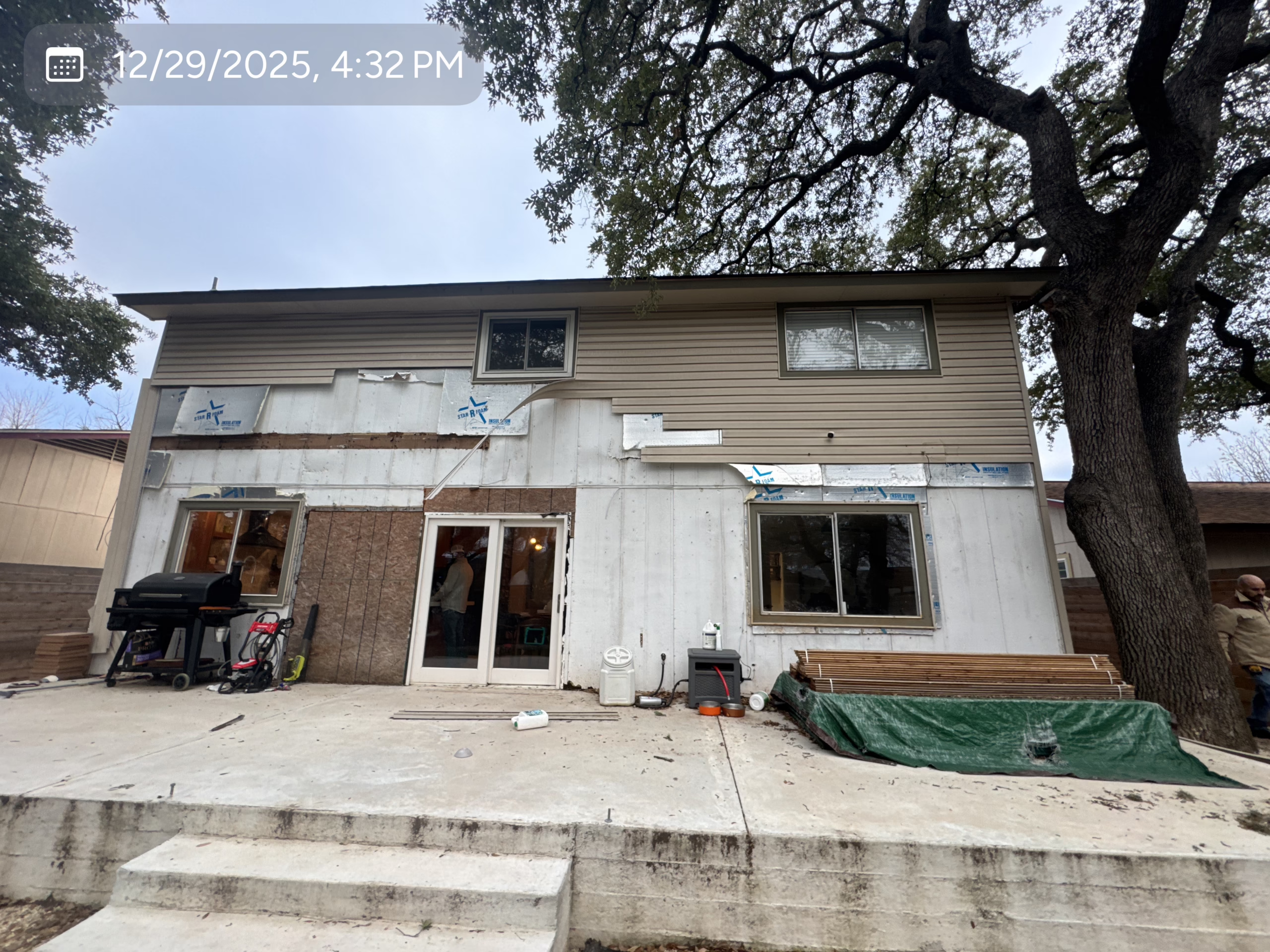
Fiber Cement vs. Vinyl Siding in Austin, TX — Which Is Right for Central Texas?
Vinyl costs less installed and never needs painting. Fiber cement costs more, needs periodic repainting, and demands a higher installation standard. In a moderate climate those vinyl advantages are real and the comparison is genuinely close. In Central Texas they erode — sustained heat warps vinyl permanently on south and west elevations, UV fading can’t be corrected with paint the way it can on fiber cement, and vinyl’s most common failure mode in this market is concealing a deteriorating substrate rather than replacing it. This page makes the comparison directly across the variables that matter here: performance under heat and UV, longevity, maintenance reality, cost, and what each material requires from the installation. For the full story on each material individually see the James Hardie fiber cement page and the vinyl siding page, or start with the siding types overview.
Fiber Cement vs. Vinyl: Head to Head
The comparison below reflects real-world performance in Central Texas conditions — not manufacturer claims from moderate climates.
| Variable | Fiber Cement (James Hardie) | Vinyl |
|---|---|---|
| Heat Performance | ✓ Dimensionally stable — doesn’t soften or warp under sustained 100°F+ temperatures | Softens at temperatures within Austin’s summer range. South and west elevations warp permanently over multiple seasons |
| UV Resistance | ✓ Paint holds 10–15 years with correct installation and quality paint. Repaintable to any color when needed | Color degrades under intense UV exposure. Faded vinyl cannot be painted with lasting results — replacement is the only correction |
| Moisture Resistance | ✓ No absorption — cement and sand substrate has no organic content to absorb water or support rot | The cladding itself resists moisture, but conceals substrate problems underneath it rather than eliminating them |
| Fire Resistance | ✓ Non-combustible — cement substrate won’t burn or melt | Combustible — melts and can spread flame. No fire resistance advantage |
| Pest Resistance | ✓ No food source for insects, woodpeckers, or rodents — inorganic substrate gives wildlife nothing to excavate | Vinyl doesn’t attract wildlife directly, but conceals wood-based substrates underneath that do |
| Paint / Maintenance | Requires repainting every 10–15 years. Correct installation front-loads the labor that protects paint longevity | ✓ No painting required — color is integral. Trade-off: can’t be repainted when faded, and color match on repairs is difficult |
| Lifespan in Texas | ✓ 30–50 years with correct installation and maintenance. 30-year substrate warranty | 20–30 years in moderate climates. Shorter on Austin south/west elevations due to thermal cycling |
| Installation Cost | Higher — heavier material, more precise installation required, preferred-standard labor adds time | ✓ Lower installed cost — lighter, faster to install, less demanding installation standard |
| Impact Resistance | ✓ Resists hail — dents rather than shatters under impact | Brittle in cold temperatures — cracks and shatters under hail impact, particularly during Austin’s occasional hard freezes |
| Substrate Disclosure | ✓ Full tear-off standard — we don’t install over unknown substrates | Historically installed over failing hardboard and T1-11 without removal — concealing rather than correcting substrate problems |
Where Vinyl’s Advantages Break Down in Central Texas
Vinyl’s core selling points — no painting, lower cost, moisture resistance in the cladding — are real advantages in the right context. Central Texas is not that context for most of them.
✗ “No Painting” Becomes “No Correction”
Vinyl’s integral color is an advantage until it fades — and under Austin’s UV intensity, fading on south and west elevations is a matter of when, not if. Unlike painted fiber cement where repainting is a straightforward maintenance task, faded vinyl can’t be painted with lasting results. The only correction is replacement. The no-painting advantage becomes a no-correction limitation.
✗ Thermal Warping Is Permanent
PVC softens at temperatures well within Austin’s summer range, and south- and west-facing wall surfaces reach significantly higher temperatures than air temperature. Once vinyl thermally warps — taking a permanent set — the deformation can’t be corrected without replacement. Thermal warping on these elevations is the most common vinyl failure mode in this market.
✗ Moisture Resistance Masks Substrate Problems
Vinyl doesn’t absorb moisture — but it was historically installed over hardboard and T1-11 that does, without removing those materials. The vinyl’s moisture resistance sealed the system in a way that accelerated substrate deterioration behind it. Vinyl that looks fine on the surface may be concealing active rot in the substrate and framing behind it — the most common discovery on vinyl replacement projects in Austin.
✗ Impact Brittleness in Cold Snaps
Vinyl becomes brittle at freezing temperatures. Austin’s occasional hard freezes — combined with hail events, which are common in Central Texas — produce cracking and shattering that fiber cement resists. A hail storm that leaves fiber cement with minor surface marks often leaves vinyl panels cracked or shattered and requiring immediate replacement.
The full catalog of vinyl failure modes in Central Texas — and what each symptom indicates about the substrate condition — is in the common siding problems overview.
Where Vinyl Still Makes Sense
We don’t install vinyl — but we’ll tell you honestly when the trade-offs might favor it for your specific situation.
When Vinyl Might Be the Right Call
- Short-term hold property where longevity isn’t the priority
- Extreme budget constraints where fiber cement’s installed cost is a genuine barrier
- North-facing elevations with limited direct sun exposure — thermal warping risk is lower
- Secondary structures where performance over decades isn’t the goal
When Fiber Cement Is Clearly the Right Call
- South or west facing elevations with sustained direct sun
- Long-term ownership where total cost of ownership matters more than upfront cost
- Homes in areas with wildland-interface fire exposure
- Any home where the substrate assessment reveals hardboard or T1-11 underneath existing vinyl
- Homes where a prior vinyl installation over failing substrate needs to be corrected properly
The Cost Comparison — Upfront vs. Total Cost of Ownership
Vinyl costs less to install. Fiber cement costs more upfront but less over the ownership period of a home in this climate — because it doesn’t need replacing from thermal warping, doesn’t need replacing when UV fading can’t be corrected, and doesn’t fail the substrate it’s installed over.
* Prices are local estimates. Substrate correction, framing repairs, and story count significantly affect final project cost. Your actual quote is free.
The total cost of ownership calculation also includes replacement cycles. Vinyl that thermally warps on south and west elevations within 15–20 years in this climate is replaced on a shorter cycle than fiber cement. Each replacement cycle is a new installed cost. Over a 30-year ownership period, a single fiber cement installation with one repaint typically costs less than two vinyl installations — even accounting for the higher upfront cost of fiber cement.
The Variable That Affects Both Materials: Installation Quality
The comparison above assumes both materials are correctly installed. Installation quality affects both — but the consequences of installation shortcuts are more visible and more consequential on fiber cement than on vinyl, because fiber cement’s performance ceiling is higher and the gap between correct and incorrect installation is wider.
James Hardie publishes two installation tiers: “allowed” — the minimum that keeps the warranty technically intact — and “preferred” — what Hardie recommends for maximum system performance. Most contractors install to allowed because it’s faster. Early paint failure, wavy appearance, and premature moisture entry on fiber cement installations are almost always the result of allowed-standard shortcuts rather than material failure. We install to preferred standard on every project. How that process works — from substrate assessment through trim completion — is on the siding installation process page.
Frequently Asked Questions
Is fiber cement really worth the extra cost over vinyl in Texas?
For most Austin-area homeowners planning to own their home for more than a decade, yes — for three reasons specific to this climate. First, vinyl thermal warping on south and west elevations shortens the real-world lifespan of vinyl in Central Texas compared to what manufacturers claim in moderate climates. Second, faded vinyl can’t be corrected without replacement, eliminating a significant maintenance option that painted fiber cement retains. Third, fiber cement’s non-combustible substrate and resistance to pest damage are genuine advantages in Austin’s environment. The upfront cost difference is real, but so is the performance gap when you account for what this climate actually does to exterior cladding over 20–30 years.
Does fiber cement require more maintenance than vinyl?
In one respect, yes: fiber cement requires repainting every 10–15 years in Central Texas conditions. Vinyl doesn’t require painting. That’s a real maintenance difference. The trade-off is that fiber cement is repaintable when the finish degrades — you choose the timing, the color, and the quality. Vinyl is not repaintable with lasting results — when it fades or its color no longer suits you, replacement is the only option. For homeowners who prefer a set-and-forget exterior, vinyl’s no-paint requirement is a genuine advantage. For homeowners who want long-term control over their home’s appearance and condition, fiber cement’s repaintability is the more flexible system over time.
Can vinyl and fiber cement be used together on the same home?
Technically yes — but we don’t recommend it on Austin-area homes, and here’s why. Vinyl and fiber cement have significantly different thermal expansion characteristics. Where they meet at trim transitions, the differential movement creates joint stress that is difficult to seal permanently. More practically, mixing materials on a home creates an aesthetic inconsistency that’s hard to resolve and complicates future maintenance. If the goal is replacing failing vinyl on some elevations while keeping acceptable vinyl on others, a professional assessment of the overall condition usually finds that the retained vinyl is closer to failure than it appears — and that full replacement in a single scope is more cost-effective than a staged approach.
How much longer does fiber cement last than vinyl in Austin?
In Central Texas conditions with correct installation: fiber cement realistically lasts 30–50 years with periodic repainting. Vinyl typically runs 20–30 years in moderate climates — shorter on south and west elevations in Austin where thermal cycling accelerates the warping and color degradation that precede replacement. In practice, the delta is 10–20 years on comparable installations in this market, with fiber cement consistently reaching or exceeding its warranty period while vinyl frequently falls short of it on the most exposed elevations.
Why doesn’t Cupcake install vinyl if it’s cheaper?
Because in Central Texas conditions — the sustained heat, UV intensity, and thermal cycling this climate produces — we don’t think vinyl is the right recommendation for the majority of replacement projects here. It warps on the elevations with the most sun exposure, can’t be corrected when it fades, and has historically been installed over failing substrates in a way that hides rather than solves the problem. We’d rather tell you that honestly and lose the jobs where someone wants vinyl than install a product we don’t believe serves Austin homeowners well in this climate. For the situations where vinyl genuinely makes sense — short holds, extreme budget constraints — we’ll have that conversation too.
Trying to Decide Between Fiber Cement and Vinyl? Let’s Talk Through Your Specific Situation.
We’ll give you an honest recommendation based on your home, your goals, and what the substrate assessment reveals — not a default answer. Review our siding installation checklist or what to expect on your appointment before we talk.
- Material recommendation based on your actual conditions
- No deposit required to get started
- Written scope before any work begins
- 10-year workmanship warranty on every installation