

Siding Installation Process Austin TX | Preferred vs. Allowed Standard | Cupcake Home Improvements
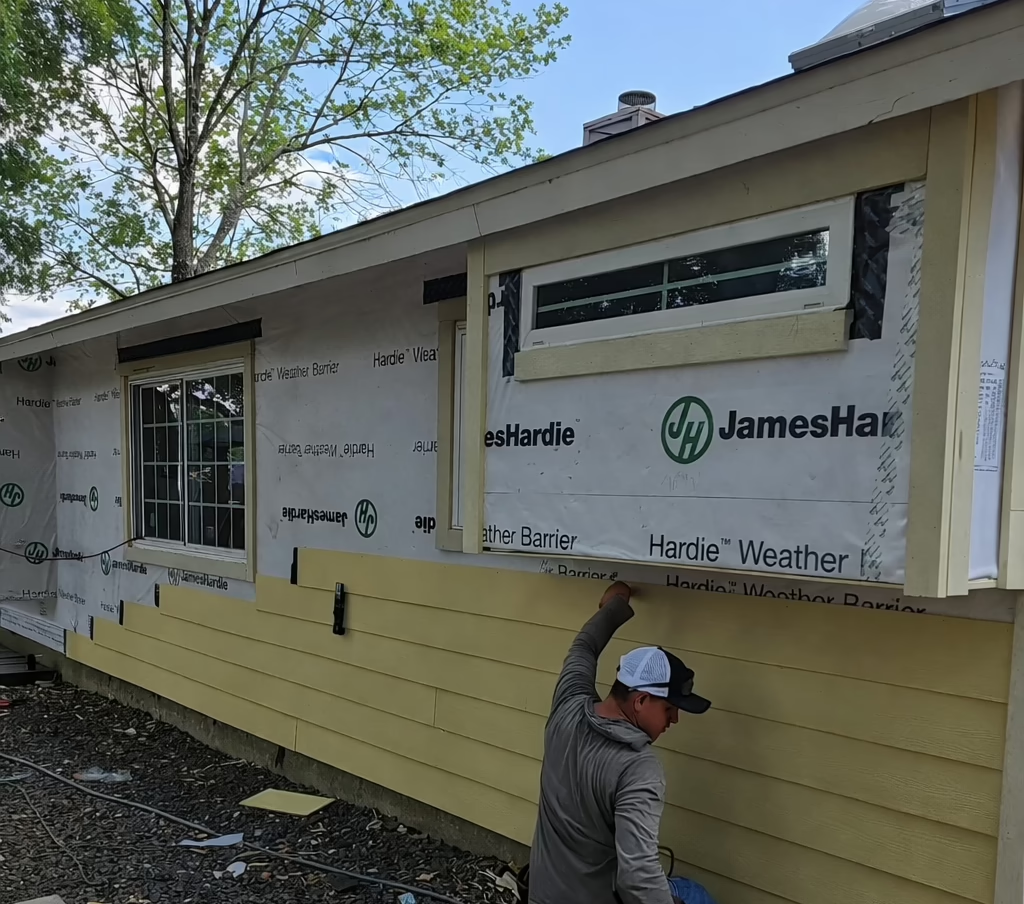
James Hardie fiber cement siding installation at preferred standard involves eight steps: full tear-off and substrate assessment, new OSB sheathing, Hardie Wrap WRB, flashing at every transition, starter strip, HardiePlank installation, HardieTrim butt-to method, and two coats of Sherwin-Williams Duration paint. Most installations that fail do so because one or more of these steps was skipped — not because the material failed. This page covers what each step requires and why cutting any one of them compromises the system. For what it costs see the siding cost page, or for the full overview see the siding replacement overview.
Three Ways to Install Hardie — and What Each One Actually Means
James Hardie publishes installation requirements, but not all contractors follow them to the same standard. In practice, three distinct tiers exist in this market — and understanding which one you’re getting determines whether the job performs as the product is capable of performing.
“Chuck in the Truck”
- Uninsured or underinsured — you absorb liability for any damage
- No OSB sheathing — boards nailed into whatever was there
- “Trim over” method — siding installed over existing trim, not butt-to
- No starter strip — first course not properly angled or sealed
- Generic housewrap or nothing — not Hardie Wrap WRB
- Flashing skipped or improvised at transitions
- One coat of paint or none — primed and left to the homeowner
- No workmanship warranty — leaves when the job is done
Outcome: Will need to be done again. When is the question.
Hardie Approved (Warranty Minimum)
- Meets minimum Hardie installation requirements — technically compliant
- May allow no OSB sheathing — boards fastened to studs only
- May use “trim over” method — permitted in HZ10 but not preferred
- Generic weather-resistant barrier acceptable — not Hardie Wrap
- Future warranty claims are uncertain — Hardie may investigate installation method before approving
- Meets code but leaves performance on the table
Outcome: Better than Chuck. Still not what the product is capable of.
Hardie Preferred Standard
- Full tear-off and substrate assessment before anything is ordered
- New OSB sheathing — armor for the home, full nailable surface
- Hardie Wrap WRB — Hardie products touch only Hardie or metal
- Starter strip at every first course — boards angled correctly, bottom sealed
- Butt-to joints at all trim — required preferred standard, not trim-over
- Joint flashing at every butt joint
- Two coats Sherwin-Williams Duration paint
- 30-year manufacturer warranty fully enforceable
Outcome: What the product is designed to do. What we install.
Preferred Standard Installation: Step by Step
This is what a correctly installed fiber cement system actually involves — from initial assessment through final paint coat. Each step exists for a reason, and skipping any one of them compromises the system downstream.
Full Tear-Off and Substrate Assessment
Every project begins with complete removal of existing cladding — no new system goes over an unknown substrate. This is non-negotiable, and it’s the step most often skipped by contractors who are trying to reduce scope and win on price.
Once the cladding is off, we inspect the sheathing, framing, and existing water-resistive barrier section by section before anything is ordered or installed. On homes where vinyl was previously installed over hardboard or T1-11, this is the step where the actual condition of the wall becomes visible for the first time in years. We document with photos before any corrections begin — you see exactly what we found.
- All existing cladding removed completely — no installation over unknown substrate
- Sheathing inspected for moisture damage, soft spots, and structural compromise
- Framing assessed for rot, out-of-plumb studs, or missing blocking
- Existing flashing failures identified at roof-to-wall transitions and window surrounds
- Corrections completed before any new material is installed over the wall
New OSB Sheathing
New OSB sheathing is the armor for the home — a full nailable surface that gives the fiber cement boards a consistent, sound substrate to fasten into, adds structural rigidity to the wall, and provides an additional layer of thermal performance. Without new sheathing, boards fasten only at studs, and any unevenness in the framing telegraphs directly through to the finished surface.
This is the line item most often excluded from lower-priced quotes. When a contractor skips sheathing, they’re nailing into whatever substrate existed before — often degraded, often uneven, and always unverified. A quote that doesn’t include sheathing is a fundamentally different scope.
- 7/16 in. OSB or equivalent APA-rated sheathing installed over corrected framing
- Irregularities and unevenness in framing corrected before sheathing goes on — these telegraph through to finished siding
- Sheathing provides full nailable surface for correct fastener placement and spacing
Hardie Wrap Weather-Resistant Barrier
Hardie products are designed to touch only two things: another Hardie product or metal. That means the weather-resistant barrier behind the cladding needs to be Hardie Wrap — not generic housewrap and tape from the lumber yard. Hardie Wrap is a non-woven, non-perforated polyolefin WRB engineered for compatibility with fiber cement: better moisture management, better dimensional stability, and a system that was designed to work together.
Generic WRBs are cheaper and faster to install. They’re also less compatible with the system they’re supposed to protect. The WRB is the last line of defense if any moisture ever gets behind the cladding — the single most important time to have the right product is the one time it actually matters.
- Hardie Wrap installed before any window or door installation — not on saturated sheathing
- Installed horizontally with print side facing out, extending minimum 6 in. around building corners
- Vertical seams overlapped minimum 6 in. and taped; horizontal seams overlapped minimum 6 in. in shingle-lap fashion and taped
- Bottom edge extends minimum 1 in. over sill plate and foundation interface
- Hardie Wrap Flex Flashing at all window sills; Pro-Flashing at jambs and head
- All penetrations sealed — blocks around any opening 1½ in. diameter or larger
Flashing at Every Transition
Flashing is unglamorous scope that doesn’t show in the finished product — which is exactly why it’s the first thing cut on a rushed or low-bid installation. It’s also where the majority of serious moisture failures originate. Every transition point where water can find its way behind the cladding gets a flashing detail. No exceptions.
- Kickout flashing at every roof-to-wall transition — minimum 4×4 in., angled 100°–110° to direct water away from wall
- Step flashing up every roof rake, with WRB lapping over the top
- Self-adhering membrane at roof-wall intersections before subfascia or trim goes on
- Head flashing above every window and door — tucked under WRB, overlapping trim
- Z-flashing at all horizontal seams on two-story applications
- Gutter end caps maintain minimum 1 in. clearance from siding — gutters never attached directly to HardieTrim
- Minimum 6 in. clearance between finished siding and grade — 1–2 in. from decks, slabs, and solid surfaces
Starter Strip
The starter strip is a ripped piece of HardiePlank installed beneath the first course to set the correct angle and create a proper drip edge at the bottom of the wall. Without it, the first course of siding sits flat against the wall rather than angling correctly outward — and the bottom edge, where moisture is most likely to contact the board, isn’t properly sealed.
Skipping the starter strip is one of the most common shortcuts on rushed installations and one of the most common causes of accelerated bottom-course deterioration.
- 1¼ in. ripped pieces of HardiePlank installed even with bottom of sheathing
- Installed over WRB with occasional gaps left for drainage — never fully sealed along its length
- First course bottom edge positioned minimum ¼ in. below starter strip edge
- Chalk line snapped at every stud location on WRB for accurate fastening
HardiePlank Installation — Preferred Method
The plank installation itself has more precision requirements than most homeowners realize — and more ways to shortcut. Fastener depth, joint placement, butt treatment, and the relationship between planks and trim all affect long-term performance.
- Blind nailing method — fasteners 1 in. from top edge, no closer than 3/8 in. from ends, driven flush not overdriven
- Butt joints land on studs only — never between studs
- Butt joints staggered minimum 2 stud bays (32 in.) between consecutive courses
- Joint flashing — 6 in. wide Hardie Wrap at every butt joint, overlapping course below by 1 in.
- 1/8 in. gap between plank ends and vertical trim — filled with permanently flexible caulk
- Factory ends used at all butt joints whenever possible — cut ends sealed before installation
- Chalk line checked every 3–5 courses to maintain level and straightness
- Butt joints kept at least one course away from window and door openings
HardieTrim — Butt-To Method
Hardie’s preferred standard requires butt-to trim installation — trim boards installed before siding, with siding run to the trim rather than over it. “Trim over” is technically permitted in HZ10 zones but is not the preferred standard and is the method most commonly used by contractors cutting time. Butt-to produces cleaner flashing details, better long-term performance at every trim-to-siding junction, and a caulk joint that can be maintained over time without pulling trim.
- HardieTrim 5/4 or 4/4 boards installed before siding at corners, windows, and doors
- Siding run to trim leaving 1/8 in. caulked gap — never siding over trim
- Head flashing over all window and door trim — tucked under WRB
- Flashing over trim with ¼ in. gap — do not caulk between siding and flashing
- Fascia installed over wood or steel sub-fascia only — not as structural replacement
- All cut edges sealed or back-primed before installation
Two Coats of Sherwin-Williams Duration
Factory-primed Hardie must be painted within 180 days of installation. We paint every project with two coats of Sherwin-Williams Duration — a 100% acrylic exterior paint engineered for the heat and UV conditions of Central Texas — applied after all installation details are verified complete. Paint applied over incorrectly installed siding, over unsealed cut edges, or before all penetrations are sealed will fail faster than the same paint on a correctly prepared surface.
Painting is included in our price — it’s not a separate mobilization or a separate contractor. Two coats, correctly applied, on a correctly installed substrate, should hold 10–15 years in Central Texas conditions before needing attention.
- All cut edges sealed before paint is applied
- All penetrations and caulk joints completed before painting begins
- 100% acrylic primer coat followed by two finish coats of Sherwin-Williams Duration
- Back-rolling applied where siding is sprayed for proper penetration
- Applied within Hardie’s specified timeframe — never to saturated product
What Preferred-Standard Installation Delivers
When every step above is done correctly, the installed system performs at the ceiling of what fiber cement is capable of in Central Texas conditions.
Water Resistant
A correctly installed wall system manages water at every transition point — grade clearance, kickout flashing, step flashing, head flashing, sealed penetrations, and a continuous WRB behind the cladding. No entry point for water means no substrate moisture accumulation, no rot sequence, and no repeat projects.
Pest Resistant
Fiber cement has no organic content for insects, woodpeckers, or rodents to consume. Correct grade clearance and sealed penetrations eliminate the entry points that give wildlife access to the wall cavity. The pest resistance that makes fiber cement attractive on paper only holds when the installation removes the access points.
Class A Fire Rated
James Hardie fiber cement carries a Class A fire rating — the highest available — when installed correctly. Insurance companies may discount your homeowner’s policy for upgrading to a Class A fire-rated cladding system. That discount requires correct installation — a fiber cement job that doesn’t meet Hardie’s standards doesn’t necessarily retain the rating.
30-Year Manufacturer Warranty
Hardie’s 30-year substrate warranty is enforceable when the installation meets preferred standard. It’s technically active on allowed-standard installations too — but warranty claims trigger an investigation of installation method, and installations that cut the details that preferred standard requires often don’t survive that investigation. Preferred standard means the warranty means what it says.
How all of this applies to your specific home — what the substrate assessment finds, what corrections are needed, and what the full preferred-standard scope looks like — is covered on the siding appointment page. The full list of what a correctly installed project includes is on the siding installation checklist.
Frequently Asked Questions
What’s the difference between Hardie’s “allowed” and “preferred” installation standard?
Hardie publishes two tiers. Allowed is the minimum required to keep the warranty technically intact — it permits certain shortcuts including no OSB sheathing and trim-over installation that preferred standard doesn’t allow. Preferred is what Hardie recommends for maximum system performance: full sheathing, Hardie Wrap, butt-to trim, starter strip, and all the water management details done correctly. Most contractors install to allowed because it’s faster and cheaper. The performance gap between the two tiers shows up in year three through eight — peeling paint, moisture entry, and premature substrate deterioration that gets blamed on the product when the installation was the actual failure.
Why does new sheathing matter if the existing sheathing looks fine?
Existing sheathing condition can only be reliably verified after tear-off — surface appearance from outside doesn’t confirm what the sheathing looks like from the inside. New OSB sheathing gives the fiber cement a consistent, flat, fully nailable surface that the fastener schedule assumes is there. Without it, boards fasten only at studs across potentially uneven or aged substrate, and any framing irregularities telegraph through to the finished siding. The sheathing is also what makes the extra thermal layer argument meaningful — it adds a complete additional barrier between conditioned interior space and the exterior. Excluding it upfront, before the wall is even opened, is a scope cut not a finding.
Why does it matter whether the WRB is Hardie Wrap vs. generic housewrap?
Hardie products are engineered to touch only Hardie products or metal — the Hardie Wrap WRB is designed for compatibility with the fiber cement system in terms of vapor permeability, moisture management, and long-term performance behind the cladding. Generic housewrap is cheaper and faster to install and meets code minimum. It’s also less compatible with the system it’s protecting. The WRB is the last line of defense if moisture ever penetrates the cladding — it only matters in the rare situation where it’s tested, and that’s exactly when you need the right product.
What is “butt-to” trim installation and why does it matter?
Butt-to means trim is installed before siding, and siding is run to the trim leaving a small caulked gap. Trim-over means siding is installed first and trim is nailed over the top. Hardie’s preferred standard requires butt-to because it produces cleaner flashing integration — head flashing above windows can be properly tucked under the WRB and over the trim in the correct sequence. Trim-over shortcuts this flashing sequence and is one of the most common installation details that fails over time at window and door surrounds, where moisture entry concentrates.
Is painting really included in your siding replacement price?
Yes. Two coats of Sherwin-Williams Duration, applied after all installation details are verified complete. This is not a separate mobilization and not a separate contractor. A quote that doesn’t include painting is a lower number on paper — and a second contract you’ll need to sign before the project is actually done. More practically, painting before all penetrations and caulk joints are complete produces premature paint failure that gets blamed on the paint rather than the sequence. We paint last because the correct sequence produces a finish that holds.
Want to Know What Preferred-Standard Installation Looks Like on Your Home?
We’ll assess what’s there, tell you what the substrate needs, and give you a written scope that documents every detail before any work begins. Review what to expect on your appointment before we talk.
- Preferred-standard installation on every project — not contractor minimum
- No deposit required to get started
- Written scope before any work begins
- 10-year workmanship warranty on every installation